High-Definition (HD) FAQs
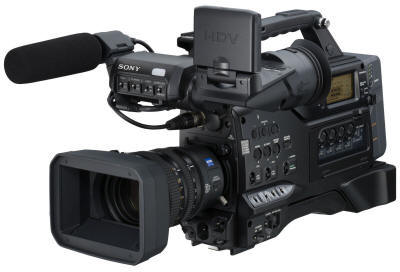
Our Sony HVR-S270U
camera records directly to CF cards for a faster workflow.
It has long
been our objective to help you relive your wedding day to the
fullest by capturing the details of your day with the latest
technology available. We are excited once again to lead the way
by ushering high-definition (HD) wedding videography on Blu-ray
discs into the Indianapolis market.
New and
existing clients can now upgrade to HD packages in order to
ensure a viewing experience that will truly immerse the couple
right back into their special day. Our competitors and
colleagues in the wedding videography industry will also be
given access to our equipment in order to spread the gospel of
HD to their own clients.
Our goal is
to ensure that as many couples as possible, whether they hire us
or not, will have the opportunity to fully enjoy the clarity of
HD, and that ultimately, the bridal community at large will
continue to grow in appreciation for the unique power of
professional videography to preserve the best day of your life.
Rather than
rewrite much of the valuable information that is already widely
available on the internet, we will reprint an excellent article
below after addressing the most common question:
What
equipment do I need to watch my Blu-ray video at home?
To enjoy your
Blu-ray video at its fullest quality, you will need an
HD-capable television and a Blu-ray player. Keep in mind that
not all Blu-ray players on the market support recordable BD-R
media (yet). Be sure to test your wedding video in a
player before you buy it, or if you plan to buy a player prior
to your wedding, we can loan you a disc to test. We give
our highest recommendation to the Panasonic DMP-BD60 ($242) for
its combination of price,
compatibility and fast loading times.
You can also
enjoy your Blu-ray video in a BD-ROM drive (as low as $89)
connected to your computer's HD monitor with the appropriate
software and system requirements. Please visit
http://www.blu-ray.com/faq/ for more details.
Your video
will also be burned onto standard DVD media for you to enjoy in
your regular DVD player for the time being if that is all you
have. Then you can enjoy your HD video down the road once
you're ready to upgrade to the necessary equipment.
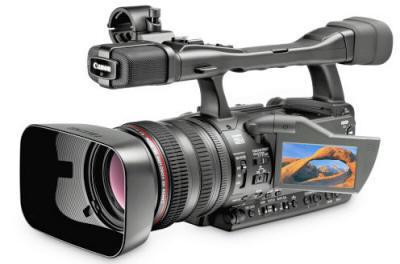
Our Canon XH-A1
camcorder adds versatility and portability to our creative
arsenal.
Reprinted
from WeddingChannel.com:
What Is
High Definition Anyway?
High Definition (HD) is the highest level of picture quality
available, offering increased image resolution and detail. With
more than twice the pixels (or lines) of resolution than Digital
Video (DV) offers, Hi-Def must be screened on a HDTV (High
Definition TV) for viewers to appreciate the difference in
quality. High Definition Video (HDV) is shot at 1080 pixels,
while Standard Definition uses 480 pixels.
Can You
Say That In English?
The easiest way to understand Hi-Def is to think of widescreen
movies, the inspiration for HDV in the first place. You're at
the megaplex watching a film on a widescreen, or
rectangular-shaped screen. At home, if you have a traditional
standard television set, you're watching a movie or show on a
box, or square-shaped screen, therefore missing out on the extra
action that takes place on the sides (because it has been
clipped or "letterboxed" to fit the square shape). If you have a
HDTV (the newer rectangular shaped TV), often when you view
shows or movies, they are letterboxed (clipped with black on the
sides) because they have not been shot in High Definition Video
yet. One reason why movies at the theater are so much more
captivating is because the screen occupies a greater field of
view, especially peripherally, making you feel like you are
actually there, experiencing the action.
A Little
Perspective
While many shows are not yet shot in HD, they soon will be. In
fact, by 2009, all analog transmissions of television will cease
to operate in the United States. Translation? If you don't have
a digital or Hi-Def TV (or at least a digital tuner), you won't
be able to receive television broadcasts. Times they are a
changing (the last time a major change in TV transmission
standards took place was in the late 1950s, when color was
added).
The
Digital Dish
In a nutshell, anything preceding digital is considered analog,
and there are three main types of digital TV. The first is
Standard Definition (good), which offers basically the same
resolution as the traditional analog system, followed by
Enhanced Definition (better), and the third, High Definition
(best). High Definition is quickly gaining acceptance and is the
future industry standard, with many wedding videographers now
offering it as an option alongside their Standard Definition
videos.
What Are
The Pros of High Definition Video?
Quite simply, clarity and detail. The resolution is outstanding
and breathtaking, like looking through a window. The average
resolution for VHS is 240 pixels, DVD is 430 pixels, Standard
Television is 480 pixels, with HDTV surpassing them all at 1080
pixels. It is the best.
What Are
The Cons of High Definition Video?
From a pure visual and aesthetic perspective, there are no cons.
However, the equipment is still relatively more expensive for
studios and consumers to acquire, even though it is becoming
more and more affordable by the day. But because of this extra
cost, many videographers have not yet adopted the new technology
and do not yet know how to use the new equipment, as the HD
cameras are far more advanced so there is a slight learning
curve involved. Those who have, may not have mastered it yet.
For instance, if a videographer isn't that familiar with the
technology yet, it can be harder for him/her to shoot in low
light, but with proper and good lighting conditions, you can see
significantly more detail from HD video than is possible from
Standard Definition. Also, weddings shot with HDV cameras are
normally distributed as traditional video on standard DVDs at
this time, since Blu-ray players are just recently becoming more
available and affordable.
So Why
Should You Consider It?
Essentially, because you may be future-proofing your wedding
video. Imagine watching your parents' wedding video now. Do you
even still have a VCR to play a VHS tape? Just as this format
has all but become obsolete, Standard Definition might someday
be as well. Those of us lucky enough to be getting married right
now have landed in this awkward in-between technology phase.
Many videography studios are starting to offer Hi-Def but many
still aren't. If you have your wedding video shot in Standard
Definition, you won't be able to take advantage of the higher
resolution and detail, but a videographer may be easier to
find. Ultimately, the decision is yours - and now that we've
given you the skinny, you can make the best choice for you.




